Casper Ruud Net Worth 2026 - How Norway's Consistent Champion Turned Clay Court Excellence Into Commercial Gold
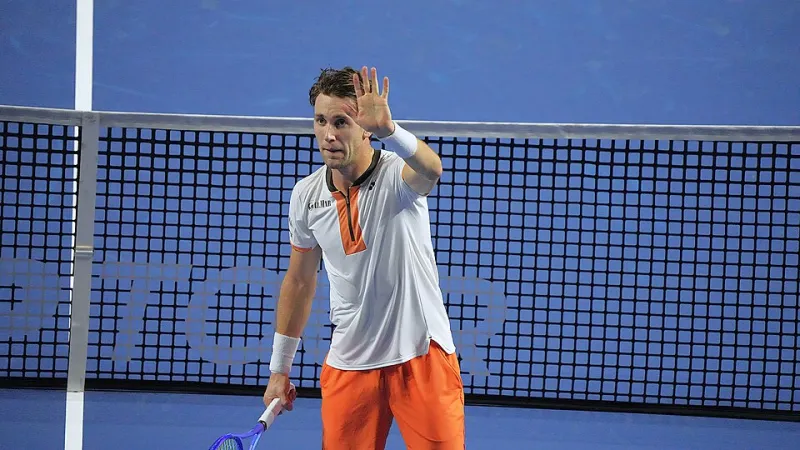
Photo: Skyscraper2010, CC BY-SA 4.0, via Wikimedia Commons
In a sport populated by flamboyant personalities and viral moments, Casper Ruud has carved out his financial success through a decidedly different approach: steady excellence, professional discipline, and a commercial strategy that prizes long-term partnership over short-term spectacle. The Oslo-born Norwegian, who has reached three Grand Slam finals and established himself as one of the most reliable performers on the ATP Tour, has accumulated an estimated net worth of approximately $25 million as of 2026 — a figure that reflects both his considerable on-court earnings and the carefully cultivated brand that has attracted premium sponsorship relationships.
A Tennis Family's Investment Pays Off
Born on December 22, 1998, Casper Ruud's path to professional tennis was shaped by an environment that understood the sport from the inside. His father, Christian Ruud, was a professional player who reached a career-high ranking of 39 in the world during the 1990s, and the elder Ruud's knowledge of the tour — its demands, its financial realities, and its pitfalls — has been instrumental in guiding his son's development and career management.
Casper turned professional in 2015 and spent formative years training at Rafael Nadal's academy in Manacor, Spain — the Rafa Nadal Academy. That association with tennis royalty sharpened his game and, perhaps equally importantly, provided a framework for professional preparation that has underpinned his subsequent success. By 2020, he had broken into the top 30. By 2022, he was a Grand Slam finalist.
Prize Money: The $20 Million Foundation
Ruud's cumulative ATP prize money through 2026 has exceeded $20 million, a testament to the financial rewards that consistent deep runs at major tournaments can generate. His most significant earnings have come from three Grand Slam final appearances — the 2022 French Open (lost to Rafael Nadal), the 2022 US Open (lost to Carlos Alcaraz), and the 2023 French Open (lost to Novak Djokovic) — each of which delivered runner-up checks in the range of $1.5 to $2.5 million.
While the Grand Slam titles themselves have thus far remained beyond his grasp, the financial difference between winning and finishing as runner-up at a major is considerably smaller than the sporting difference. Each of those three finals appearances generated substantial prize money that has compounded his career earnings significantly.
Beyond the Slams, Ruud has been remarkably consistent at the ATP 250 and 500 level, claiming multiple titles annually at clay court events across Europe and Latin America. This steady accumulation of smaller prize checks — each contributing to a running total that most players would envy — has been a defining feature of his financial profile.
The Sponsorship Portfolio: Quality Over Quantity
Ruud's commercial partnerships reflect the same measured, quality-focused philosophy that characterizes his tennis. Rather than assembling a sprawling roster of minor deals, his team has prioritized fewer, more substantial relationships with brands whose values align with his professional image.
His most prominent apparel partnership is with Nike, whose association with Ruud provides both financial compensation estimated at $1.5 to $3 million annually and access to the American sportswear giant's global marketing infrastructure. For a Norwegian player seeking to build name recognition in the crucial US market, the Nike association carries significant strategic value beyond the immediate financial terms.
His racket partnership with Babolat, the French manufacturer whose products are used by a significant portion of the clay court elite, is estimated to contribute an additional $500,000 to $1 million per year. The Babolat relationship carries a natural narrative coherence given Ruud's clay court identity and his training background at the Nadal Academy — a facility where Babolat rackets are ubiquitous.
Additional partnerships with Rolex (whose ambassador roster includes many of tennis's most respected figures), regional Norwegian brands, and ATP-level sponsors contribute to an annual endorsement income estimated at $4 to $6 million.
The Family Factor in Financial Strategy
One of the distinctive elements of Ruud's financial story is the continued involvement of his father in his professional management. Christian Ruud's firsthand experience of professional tennis — including its financial uncertainties and the importance of sound money management — has informed a conservative, long-term approach to wealth building that stands in contrast to the more aggressive commercial strategies pursued by some of Casper's peers.
This family-guided approach has prioritized stable, reputable partnerships over higher-risk, higher-reward ventures. It has also meant that Ruud's financial infrastructure was professionally managed from an early stage, avoiding the costly mistakes that some young athletes make when commercial success arrives before financial literacy.
Clay Court Dominance as a Commercial Identity
Ruud's identity as one of the premier clay court players of his generation has created specific commercial opportunities that a more generalist player might not access. The clay court season — centered on the European spring and culminating at Roland Garros in Paris — carries significant prestige and generates substantial sponsor interest, particularly from European and Latin American brands.
His repeated success at clay events in South America, including victories in Buenos Aires and Bastad, has built him a devoted following in markets that are often underserved by tennis's traditional commercial infrastructure. This geographic diversity in his fan base has made him attractive to sponsors seeking access to Latin American consumers — a growing and commercially significant demographic in the global tennis market.
Real Estate and Personal Investments
Ruud is based in Monte Carlo, the Monaco principality that serves as home base for a significant community of European tennis professionals. His property investment there reflects both the lifestyle preferences common among top-ranked players and the sound financial logic of establishing residence in a low-tax environment during peak earning years.
Beyond Monaco, Ruud maintains strong connections to Norway, where his family background and national sporting hero status have generated interest from Norwegian businesses seeking association with one of the country's most internationally recognized athletes. The Norwegian market, while smaller than those of Germany or France, offers Ruud a degree of commercial exclusivity — as the country's preeminent tennis figure — that players from more tennis-saturated nations cannot replicate.
Outlook for 2026 and Beyond
At 27 years old in 2026, Ruud is entering what should be the most financially productive phase of his career. His ranking in the top ten ensures continued access to the prize money pools at the sport's most lucrative events, and his established sponsor relationships provide a stable commercial income stream that is unlikely to be disrupted by normal fluctuations in on-court results.
A first Grand Slam title — which would transform his commercial profile dramatically — remains a realistic ambition, particularly at Roland Garros, where his clay court expertise gives him a genuine competitive advantage. Such a victory would likely trigger significant bonus clauses in existing contracts and open doors to new partnerships that his current status, impressive as it is, has not yet fully unlocked.
His estimated $25 million net worth in 2026 is the product of consistent, professional excellence — both on and off the court. In a sport that sometimes rewards spectacle over substance, Casper Ruud's financial story is a compelling reminder that steady, disciplined performance builds fortunes too.
All net worth figures are estimates based on publicly available data, industry reporting, and ATP financial disclosures. Individual contract terms are not publicly confirmed.