Elena Rybakina Net Worth 2026 - Kazakhstan's Tennis Champion Turns Court Success Into Commercial Gold
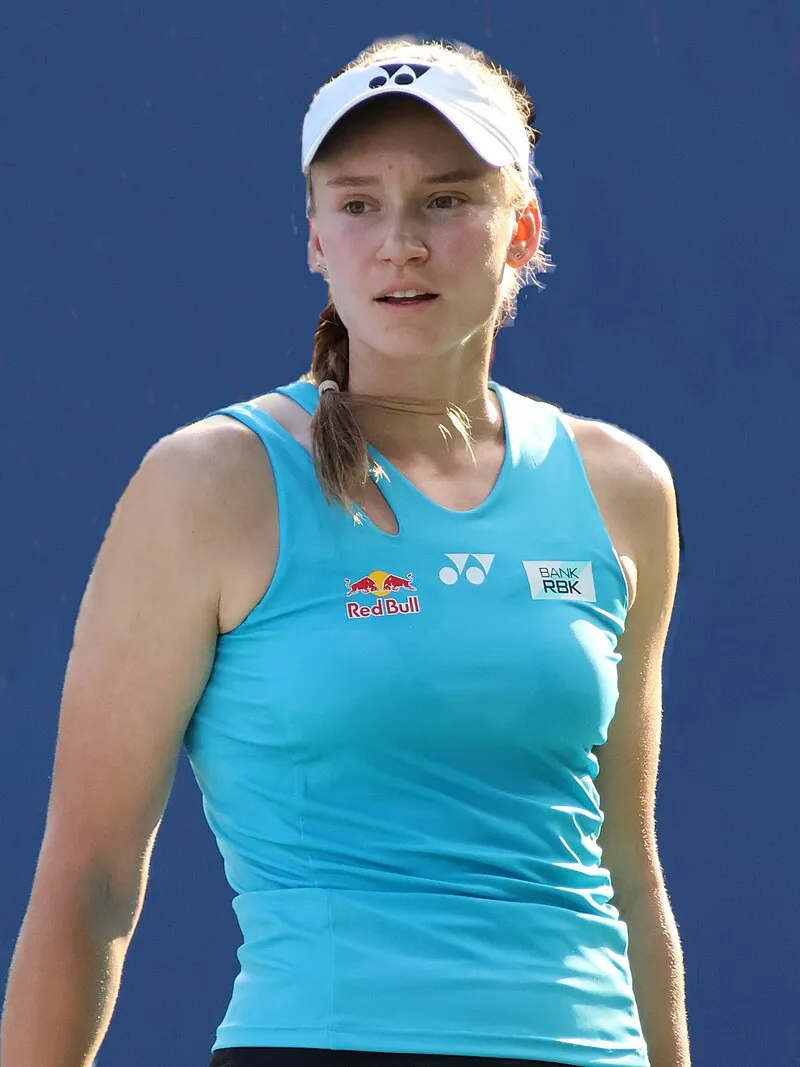
Photo of Elena Rybakina, via Wikimedia Commons
Elena Rybakina's financial ascent is among the most intriguing wealth-building stories in contemporary women's tennis — a narrative shaped by a Wimbledon title, a strategic national affiliation switch, and a quietly expanding commercial portfolio. From her origins in Moscow to her status as Kazakhstan's most celebrated athlete, Rybakina has leveraged consistent Grand Slam performance into a net worth that continues to grow with each passing season.
Estimated Net Worth: $15–20 Million (2026)
The Road From Moscow to Astana
Elena Rybakina was born on June 17, 2001, in Moscow, Russia. She demonstrated tennis aptitude from an early age, training within the Russian junior development system before a pivotal decision in 2018 changed the trajectory of her career and, ultimately, her finances. Facing limited funding and institutional support within the Russian system, Rybakina accepted an offer from the Kazakhstan Tennis Federation, which agreed to finance her development in exchange for her representing the country internationally.
The arrangement was straightforward in structure but far-reaching in consequence. Kazakhstan's investment in Rybakina's career — estimated at several hundred thousand dollars in training, travel, and logistical support during her formative years — produced a return that neither party could have fully anticipated. When Rybakina lifted the Wimbledon trophy in July 2022, defeating Ons Jabeur in the final, she became not only the first Kazakhstani player to win a Grand Slam singles title but one of the most suddenly marketable athletes in the country's history.
Prize Money: Consistent Returns at the Highest Level
Rybakina's prize money earnings have been anchored by her Grand Slam performances, which have been remarkably consistent for a player who only entered the sport's top tier in 2021. Her 2022 Wimbledon victory delivered a $2.35 million winner's check — the most significant single payday of her career to that point. The 2023 Australian Open final, where she fell to Sabalenka after a gripping three-set contest, nonetheless earned her approximately $1.5 million as the runner-up.
Deep runs at the French Open, US Open, and continued Australian Open contention have kept her prize money accumulation well above $5 million per year. Through the end of 2025, her career prize money exceeded $20 million — a figure that places her among the sport's most consistent earners despite never having held the world No. 1 ranking for an extended period.
Appearance fees represent an increasingly significant supplementary income stream. As a former Grand Slam champion with a top-five ranking, Rybakina commands appearance guarantees at the premier international tournaments, with industry estimates placing this figure at $1.5–2.5 million annually.
The Geopolitical Dimension of Her Commercial Story
Rybakina's nationality situation has created a commercial profile that is genuinely unusual in women's tennis. Born Russian but competing for Kazakhstan, she has navigated the post-2022 geopolitical landscape — in which Russian and Belarusian athletes faced widespread restrictions — with a structural advantage that her peers from those countries did not possess. She competed at Wimbledon in 2022 and won it, at a moment when Russian and Belarusian players were barred from the tournament entirely.
For sponsors, this created an intriguing calculus. Rybakina offered the athletic profile of a Russian-trained player — technically precise, physically powerful, mentally composed — without the reputational complications that had made Russian athlete partnerships more complex in Western markets. Global brands recognized this distinction, and her endorsement portfolio expanded accordingly in the years following her Wimbledon victory.
Kazakhstan's own investment in her profile has continued post-triumph. The government and its affiliated entities have supported promotional campaigns featuring Rybakina as a national icon, adding a layer of institutional sponsorship income that supplements her commercial relationships with private-sector brands.
Endorsements: Building a Global Portfolio
Rybakina's endorsement strategy has prioritized quality over quantity, a deliberate approach that has preserved the exclusivity value of her partnerships. Her primary racket sponsor is Wilson, a relationship that predates her Wimbledon victory and has since been renegotiated to reflect her elevated market position. Nike serves as her apparel partner, with a contract estimated at $3–4 million annually.
Rolex, consistent in its association with Wimbledon champions, extended an ambassador relationship to Rybakina following her 2022 title — a partnership that carries both financial and reputational weight given the brand's deep association with tennis's most prestigious tournament. Porsche, which sponsors the Stuttgart tournament and maintains relationships with top WTA players, has also engaged Rybakina in a brand ambassador capacity.
In the luxury goods and lifestyle sector, her combination of athletic achievement, understated elegance, and photogenic presence has attracted interest from brands seeking credible associations with women's sport. Industry analysts estimate her total annual endorsement income at $6–8 million, a figure that is expected to grow as her ranking consistency translates into deeper brand recognition among American and European consumers.
Real Estate and Investment Activity
Rybakina has established a residential base in Dubai, a choice that reflects both lifestyle preferences and financial pragmatism — the UAE's favorable tax environment is a well-documented attraction for elite athletes who spend the majority of their year traveling internationally. The Dubai property market, in which she is reported to hold residential assets, has demonstrated strong appreciation over the period of her investment.
Beyond real estate, Rybakina's financial advisors have directed portions of her earnings into diversified investment vehicles, though the specifics remain private. Her management structure, operated through established sports representation channels, suggests a professional approach to wealth preservation that is designed to outlast her playing career.
American Market Potential
For US-based tennis fans and the American commercial market, Rybakina represents an underexplored opportunity. Her playing style — characterized by a serve that ranks among the most powerful in women's tennis, combined with a clinical groundstroke game — makes for compelling viewing, and her performances at the US Open have demonstrated an ability to perform on the American stage.
Her relatively reserved public persona has historically limited her media footprint in the United States compared to more outspoken peers. However, as her career matures and her management team invests more deliberately in American market visibility, her commercial profile in the US is expected to expand. Appearances on Tennis Channel and ESPN, combined with growing social media engagement, are gradually building the name recognition that sustains long-term endorsement value.
Financial Trajectory
At 24 years old in 2026, Elena Rybakina is approaching the statistical peak of a professional tennis career with a financial foundation already firmly in place. An estimated net worth of $15–20 million reflects the earnings of a player who has achieved Grand Slam success and sustained top-five ranking consistency — but who has not yet fully monetized the commercial potential that her athletic profile represents.
With additional Grand Slam victories well within reach and an endorsement portfolio that continues to mature, the trajectory of Rybakina's wealth accumulation points toward a significantly larger fortune by the end of her playing career. Kazakhstan's investment in an unheralded teenage prospect from Moscow has yielded returns that neither party could have anticipated — and the dividends are still accumulating.